

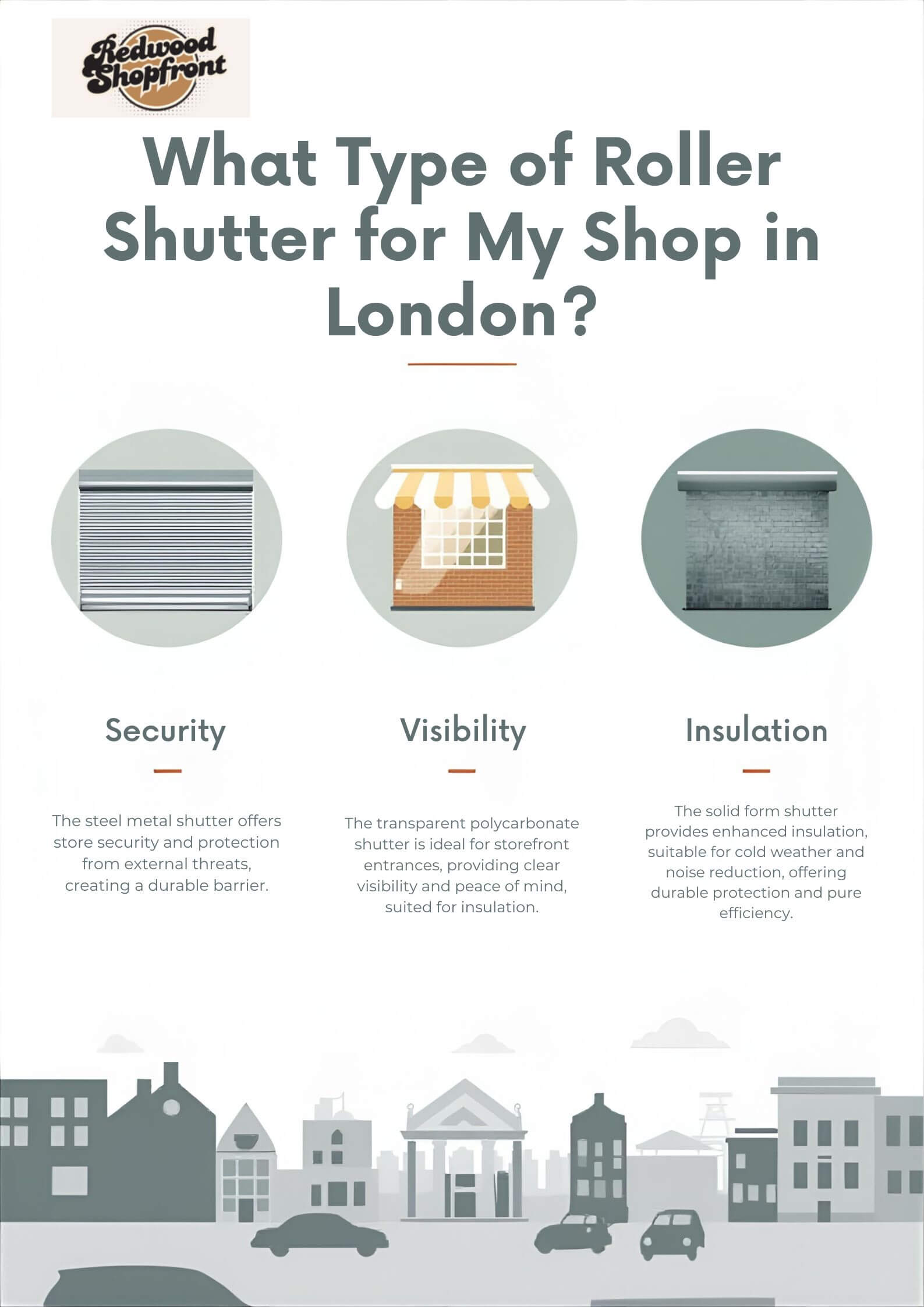
If you run a shop in London, the right roller shutter is one of the most important security decisions you’ll make. The best choice depends on your location, risk level, how much visibility you want after hours, and your budget.
In simple terms:
- Solid steel shutters are best for maximum security.
- Perforated or punched shutters are ideal when you want security and visibility.
- Insulated shutters work well where temperature, noise and energy bills matter.
Most commercial roller shutter installs in London sit somewhere between £1,000 and £4,000+ fully fitted, depending on size, spec and motorisation. HVP Security Shutters. The safest option is to get a proper survey and itemised quote from a specialist like Redwood Shopfront.
How to Choose the Right Roller Shutter for a London Shop
Before you worry about colours or controls, start with a few practical questions:
- What’s your security risk?
Are you on a busy high street, a side road, a corner unit or a retail park? - Do you need visibility after hours?
Some brands want window displays to stay visible overnight. Others prefer complete privacy. - What’s your shopfront made from?
A full glass shopfront will need different protection to a solid timber or aluminium frontage. - How often will you open and close the shutter?
High-traffic sites may need heavier-duty or industrial shutters. - Are there landlord or council rules?
Some London boroughs are stricter on “solid” shutters facing main streets.
Once you’re clear on those points, it becomes much easier to match your shop to the right shutter type.
At Redwood, we install every major shutter type across London. Here’s how they differ and when they make sense.
1. Steel High-Security Roller Shutters
If security is your top priority, solid steel shutters are usually the starting point.
- Built from strong steel laths with heavy-duty side guides and bottom rails.
- Ideal for shops in higher-risk areas, off-licences, mobile phone shops, jewellers and cash-heavy businesses.
- Block visibility completely when closed, so nobody can see your stock or layout.
Learn more about steel high security roller shutters in London.
If you have a full glass shopfront (like many modern retail units), pairing it with a solid steel shutter gives you the best mix of daytime display and night-time protection.
For the shopfront itself, see:
2. Perforated & Punched Roller Shutters (Security With Visibility)
Perforated and punched shutters are designed for security without “shutting down” the look of your shop.
- Built-in openings let people see your displays even when you’re closed.
- Often preferred on high streets, in shopping centres and by landlords who don’t want a “blank metal wall” at night.
- Good balance of security, airflow and branding.
They’re ideal for:
- Fashion, beauty and tech stores
- Showrooms and display-led brands
- Bars, cafés and restaurants that want some visibility after hours
See our dedicated page for perforated & punched roller shutters in London.
3. Insulated Roller Shutters (Security + Energy Savings)
If your shop gets cold, noisy or draughty, insulated roller shutters can do more than just lock up.
- Multi-wall, foam-filled profiles improve heat retention and noise control.
- Help reduce draughts and energy waste, especially on larger shopfronts or corner units.
- Great for workshops, trade counters, garages, cafés and mixed-use units.
- Insulated shutters are popular where the shutter is the main external door and you’re losing a lot of heat through it.
4. Industrial Roller Shutters (Heavy-Duty, Large Openings)
For warehouses, loading bays and large openings with forklift traffic or frequent cycles, you’ll usually need a more robust, industrial-grade shutter.
- Built to handle larger sizes and heavier use.
- Stronger motors, thicker steel and more robust components.
- Designed with safety edges, photo-cells and proper controls for staff safety.
If your shop is part of a warehouse or industrial estate, it’s worth stepping up to an industrial spec from the start.
5. Custom-Made Roller Shutters (Non-Standard Openings & Special Requirements)
Not every opening is simple. You might have:
- A curved or angled frontage
- Multiple small openings under one header
- Limited headroom or structural quirks
- Need to integrate shutters with signage, awnings or existing frames
In these cases, custom-made shutters are the best route:
- Built to match your exact sizes, shape and operational needs.
- Can mix solid and punched sections, special finishes, or custom fascias.
6. Garage Roller Shutters (Rear Access & Small Commercial Units)
Some shops have rear access or storage areas where a garage-style roller shutter is more practical:
- Vertical lift saves space inside the unit.
- Good for small car parks, storage garages and rear service yards.
- Can be matched to the front shutter in colour and finish for a consistent look.
Which Shutter Type Suits Your Business Best?
Here are a few quick examples to help you decide:
- Boutique, salon, fashion or tech store
You want your displays to work 24/7. A perforated or punched shutter in front of a toughened glass shop front is often the best mix. - Off-licence, phone shop, vape shop or jewellery
Security comes first. A solid steel high-security shutter in front of an aluminium shopfront is a strong choice. - Café or restaurant on a busy road
You may want some visibility, but also insulation from noise and cold. A mix of insulated and perforated shutters can work well. - Warehouse unit or trade counter
A large opening with forklift or van traffic is best served with industrial roller shutters. - Independent store with awkward frontage
Go for a custom-made shutter so it fits perfectly and works with your branding and signage.
If in doubt, ask us to look at your shopfront in person. A quick survey usually makes the decision much clearer than trying to guess from photos.
Manual vs Electric: Which Operation Is Best?
Once you’ve chosen the shutter type, you’ll need to decide how it operates.
Manual Shutters
- Best for smaller openings and lighter use.
- No motor, cables or electrics to worry about.
- Lower upfront cost, but can be physically harder to use, especially in bad weather or for taller shutters.
Electric Shutters
Recommended for most shopfronts in London, especially if you open and close daily.
- Operated with a key switch, remote control or wall button.
- Can be integrated with safety brakes, emergency stops and access controls.
While manual shutters are cheaper upfront, electric operation tends to make day-to-day trading much easier and more secure in the long term. Learn more about Manual vs Electric Shutter Repair: What Engineers Check First
How the Roller Shutter Installation Process Works
When you contact Redwood Shopfront, the process usually looks like this:
- Free site survey: We visit your premises, measure each opening and discuss your security, visibility and budget needs.
- Design & specification: We recommend the shutter type (steel, perforated, insulated, etc.), operation method and finish that fits your shopfront and landlord requirements.
- Itemised quote: You get a clear, written breakdown of all costs before any work starts, including removal of old shutters if needed.
- Fabrication: Your shutters are made to measure and finished in the agreed colour/coating.
- Installation & testing: Our engineers fit the shutters, set up the controls, test operation and make sure everything runs smoothly.
- Handover & maintenance advice: We show you how to use the shutter safely and explain basic maintenance checks.
If a shutter fails or is damaged, Redwood also offers 24/7 emergency repair across London.
Maintenance & Safety: Keeping Your Shutter Working Daily
Any commercial shutter needs basic care to stay safe and reliable:
- Regular cleaning:
Keep guides and bottom rails free of stones, rubbish and debris. - Lubrication:
Light lubrication on moving parts (where recommended by the manufacturer). - Visual checks:
Look for damage to slats, guides or bottom bars after any impact or attempted break-in. - Motor & safety checks:
For electric shutters, periodic testing by a competent engineer helps avoid failures at opening time.
Redwood can build maintenance into your installation package or provide scheduled servicing for existing shutters.
FAQs: Roller Shutters for London Shops
What is the best type of roller shutter for a high-risk London area?
Solid high-security steel shutters offer the strongest protection in busy or high-crime locations.
Do perforated or punched shutters still protect my shop while allowing visibility?
Yes, perforated or punched shutters balance security and see-through visibility after hours, making them ideal for retail displays.
Are insulated roller shutters worth it if I’m concerned about noise and temperature?
Insulated shutters help reduce noise, heat loss, and draughts while also securing the opening.
Can I get a custom shutter if my opening isn’t a standard size?
Yes, custom-made roller shutters are designed to match non-standard widths, shapes, or design requirements.
Should I choose a manual or electric operation?
Manual is cheaper and simpler for small doors; electric is easier and safer for frequent daily use.
Final Thoughts: Don’t Guess Your Shutter, Get It Designed Properly
The “right” roller shutter for your London shop is the one that:
- Matches your real risk level
- Fits your branding and visibility needs
- Works with your shopfront material and landlord rules
- Fits your budget, both now and long term
Instead of picking a shutter from a catalogue, it’s worth having it properly designed around your shop.
If you’d like tailored advice and an itemised quote, you can start on our main roller shutters in London page or contact Redwood Shopfront for a free site survey.

As the lead technical writer for Redwood Shopfront, Tom has over 7+ years of hands-on experience in the London commercial property sector, establishing himself as a leading authority on shopfront design and high-security structural glazing. Helping business owners in high-traffic areas like Soho and Walthamstow navigate complex security requirements, including LPS 1175 and PAS 24 compliance. His work ensures that every storefront is not just visually striking, but fully secured against modern threats.
Comments are closed